June 2009


IELTS Band Score: Listening 8.5, Reading 8.5, Writing 8.0, Speaking 8.0, Overall 8.5.

Best IELTS test result June 2009

IELTS Academic Module: Harpreet Kaur from India .

IELTS Band Score: Listening 8.5, Reading 8.5, Writing 7.5, Speaking 8.5, Overall 8.5.

Best IELTS test result June 2009

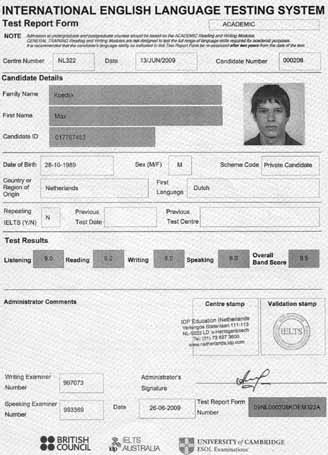
IELTS Academic Module: Max Koedijk from Netherlands.

IELTS Band Score: Listening 9.0, Reading 9.0, Writing 8.0, Speaking 8.0, Overall 8.5.

Best IELTS test result June 2009

IELTS General Training Module: Amit Thakkar from India.

IELTS Band Score: Listening 8.5, Reading 7.5, Writing 7.5, Speaking 7.5, Overall 8.0.

Best IELTS test result June 2009

IELTS General Training Module: Aik Kum Heng from Malaysia.

IELTS Band Score: Listening 7.5, Reading 8.5, Writing 7.0, Speaking 8.5, Overall 8.0.

Best IELTS test result June 2009

IELTS General Training Module: Jessica D Souza from India.

IELTS Band Score: Listening 8.0, Reading 7.0, Writing 8.0, Speaking 8.0, Overall 8.0.

Best IELTS test result June 2009

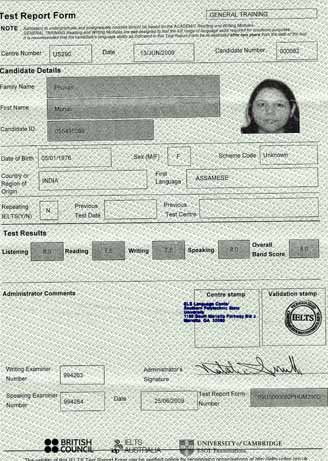
IELTS General Training Module: Monali Phukan from India.

IELTS Band Score: Listening 8.5, Reading 7.5, Writing 7.5, Speaking 8.0, Overall 8.0.

Best IELTS test result June 2009

IELTS in Malaysia - July 2009 (Academic Module)

IELTS in Malaysia was described by I. as follows (and what an excellent memory she has!):


Listening test


Section 1: A female student wanted some advice on how to go about online shopping from her male friend.

Questions: Fill in the blanks and True/False/Not Given.


Section 2: A friendly neighborhood radio announcement about an upcoming town fair, and the activities and souvenirs on offer.


Questions: A Table was given, and the task was to fill in the blanks some details: dates, types and frequency of activity, and types of souvenirs available.


Section 3: A survey conducted on usage of beauty and skin products amongst 3 different age groups: 20, 25-35 and >40.

Questions: There was a little graph and multiple choice questions were asked. There was also a short fill in the blanks section on the types of techniques used in conducting the survey.


Reading test


Passage 1: Studies and findings on alternative processes which cause less pollution than traditional sources of energy like coal and LNG. This passage was very technical.


Questions: Match the organization or the professor with their experiments and survey reports. You may use letters A-H more than once. Multiple choice questions followed.


Passage 2: A study done on Leaf-cutter Ants, the world’s smallest gardeners. They spend their time cutting leaves to make compost for gardens in which they grow fungi that they eat. The passage was very scientific in nature, and the most confusing of the 3 passages with lots of unfamiliar terms.


Questions: Information matching - confirm which paragraph letter(A-H) stated what amongst a list of 6 scientific observations. There were also 3 multiple choice questions.


Passage 3: Telepathy and Parapsychologists who investigated the causes and existence of psychic abilities. It discussed mostly the Ganzfeld experiments conducted in the 1920s, where a ’sender’ would be given 4 random images and asked to choose one, and the ‘receiver’ in another room would use telepathy to positively identify what that chosen image is. The test data gathered would then be subjected to a ‘meta-analysis’ for interpretation.


Questions: Information matching - state which paragraph corresponds to the 5 given statements/findings, A-H. We were given a table for filling in the blanks. Data to be included was dates, name of scientist, testing method and results.


Writing test


Writing Task 1 (report)

Two tables were given. We were required to report on a survey conducted on a library’s range of books (Table 1) and non-book facilities (DVDs & CDs) (Table 2) across 5 age categories. The subjects’ criteria were Very Good, Satisfactory and Poor.


Writing Task 2 (essay)

Governments have been responsible for environmental pollution. Should companies and private individuals be made to pay the costs for pollution? To what extent do you agree or disagree? State facts, your opinions and/or personal experiences you may have regarding environmental pollution.


Speaking test


- What is your full name?

- How should I call you?

- Tell me about the city you live in.

- Does your city have a swimming centre?

- Do you agree that swimming is good for you? Why?

- Do you like to attend parties?

- What kind of parties do you prefer, family parties or young people’s parties? Why?

- What is the legal age for drinking, driving and marriage in your country?

- Do you think that the legal age is suitable? Why?


- Do you agree that the legal age should be reduced to a lower age? Why?


Cue Card

Tell me about the best stage in your life. You should say:

- When that stage was.

- What you did.

- Who you did it with.

- Why it it was the best stage in your life.


Discussion

- Why do you think traditional ceremonies and national days are celebrated?


- Do you think they should be marked?

- Can we do without them? Why is it significant or insignificant to some?

- Why is it important to you?


Then I shook her hand, and said “Thank you so much for your time. I hope you have a great weekend!” Big smiles!

That was it! I think it wasn’t bad at all. Try to be as honest as possible and have a connection with the examiner when telling your little story, just like when you’re talking to your friends or family. It makes a lot of difference.


That’s all people! Enjoy trying out the questions and all the best in your IELTS!

لیست اسامی مؤسسات مجاز اعزام دانشجو به خارج

لیست اسامی مؤسسات مجاز اعزام دانشجو به خارج

جدیدترین لیست اسامی مؤسسات فعال در زمینه اعزام دانشجو به خارج از کشور که مجوز اداره کل بورس و اعزام دانشجو به خارج از کشور وزارت علوم، تحقیقات و فناوری را دارا هستند و از سوی این وزارتخانه مجاز شمرده می شوند برای اولین بار در خبرگزاری مهر منتشر شد.

به گزارش خبرنگار مهر، بر اساس اعلام اداره کل بورس و اعزام دانشجویان به خارج از کشور لیست اسامی موسسات دارای مجوز فعالیت در زمینه اعزام دانشجو به خارج از کشور و حوزه فعالیت آنها به شرح زیر است:

1- موسسه مطالعات مدیریت و فناوری / مستقر در تهران، حوزه فعالیت هلند- بلژیک - آلمان

2- موسسه پذیرش افق / مستقر در تهران، حوزه فعالیت آلمان- اتریش

3- موسسه فرهنگی و هنری ایران و استرالیا / مستقر در تهران، حوزه فعالیت در استرالیا

4- موسسه مشاوره آموزشی کاوه / مستقر در تهران، حوزه فعالیت انگلستان

5- موسسه فراز دانش پیمان / مستقر در کرمان حوزه فعالیت استرالیا- کانادا

6- موسسه مدیریت کیان اندیشه / مستقر در تهران حوزه فعالیت مجارستان- ترکیه- قبرس

7- موسسه بین المللی طبا / علم مستقر در تبریز حوزه فعالیت جمهوری آذربایجان- ترکیه

8- شرکت امین پرداز پارس / مستقر در تهران حوزه فعالیت آمریکا- کانادا

9- خدمات اعزام دانشجو به خارج از کشور نما / مستقر در تهران، حوزه فعالیت روسیه- روسیه سفید- مجارستان

10- پژواک پویندگان / مستقر در شیراز، حوزه فعالیت هندوستان- فیلیپین

11- موسسه ره یاران دانش / مستقر در تهران حوزه فعالیت مالزی

12- دانش پژوهان متین / مستقر در تهران، حوزه فعالیت مالزی

13- موسسه بین المللی پژوهشهای مدیریت ناجی / مستقر در تهران حوزه فعالیت سوئد- نروژ

14- توسعه همکاری های علمی و صنعتی ایران / مستقر در تهران، حوزه فعالیت بلاروس- اکراین

15- شعبه دانش فرا اطلاع / مستقر در تهران، حوزه فعالیت ترکیه

16- فرهنگی هنری نیلوفر آبی لوتوس / مستقر در تهران، حوزه فعالیت مالزی

17- مشاوره آموزشی و گسترش دانش کسری / مستقر در تهران، حوزه فعالیت کانادا- استرالیا- انگلستان

18- موسسه راهیان آبی دانش / مستقر در تهران، حوزه فعالیت استرالیا- نیوزلند

19- ساعی دانش آریا / مستقر در تهران، حوزه فعالیت کانادا- استرالیا- نیوزلند

20- موسسه آموزشی دکتر هنری / مستقر در تهران، حوزه فعالیت استرالیا

21- موسسه فرهنگی هنری پیشرو پژوهان / مستقر در تهران، حوزه فعالیت انگلستان- هندوستان

22- موسسه دانشور شمال / مستقر در رشت، حوزه فعالیت هندوستان- دوبی

23- شرکت توسعه دانش پیشگامان آتیه / مستقر در تهران، حوزه فعالیت سنگاپور- استرالیا

24- دانش گستران اسپادانا مستقر در اصفهان / حوزه فعالیت هندوستان

25- رهروان علم و پژوهش مستقر در تهران / حوزه فعالیت هندوستان- مالزی

26- شرکت خاور میلاد / مستقر در مشهد، حوزه فعالیت ارمنستان- اکراین

27- دانش پژوهان دیلمان / مستقر در رشت، حوزه فعالیت آمریکا- کانادا- سوئد

28- امید راه آینده / مستقر در تهران، حوزه فعالیت آمریکا- کانادا

29- خدمات دانشجویی تندیس بین الملل / مستقر در تهران، حوزه فعالیت انگلستان

30- علمی فرهنگی نخبگان پرشیا / مستقر در تهران، حوزه فعالیت آمریکا- کانادا- استرالیا

31- ایلیاد بین الملل مشاور / مستقر در تهران، حوزه فعالیت استرالیا- نیوزلند

32- تعالی دانش / مستقر درتهران، حوزه فعالیت بلاروس- چک و اسلواکی

33- آموزشی و فرهنگی افکار نوین امروز / مستقر در تهران، حوزه فعالیت کانادا- ایرلند

34- موسسه سیر دانش صدف (کاسپین) / مستقر در تهران، حوزه فعالیت اکراین- مجارستان

35- گروه مبین / مستقر در تهران، حوزه فعالیت فرانسه- آلمان- اتریش

36- موسسه فرهنگی هنری مدرسان نوین تهران / مستقر در تهران، حوزه فعالیت مالزی

37- صدرا / مستقر در تهران، حوزه فعالیت عربستان سعودی- سوریه- امارات

38- موسسه فرهیختگان زارع / مستقر در تهران، حوزه فعالیت سوئیس- هلند- آلمان

39- موسسه بهروز آرا / مستقر در تهران، حوزه فعالیت کانادا

40- دانش پویان آریا / مستقر در تهران، حوزه فعالیت مجارستان- آلمان

41- کوثر فردای سپاهان / مستقر دراصفهان، حوزه فعالیت سوئیس

42- بین المللی سفینه دانش پژوهان / مستقر در تهران، حوزه فعالیت انگلستان

43- اندیشه پارسیان باستان / مستقر در تهران، حوزه فعالیت اتریش- آلمان

44- شرکت به سوی فردای اندیشه روشن / مستقر در تهران، حوزه فعالیت هندوستان

45- مدیریت مشاوره آریا / مستقر در تهران، حوزه فعالیت انگلستان- نیوزلند- ایرلند

46- موسسه ارگان توسعه دانش / مستقر در تهران، حوزه فعالیت آمریکا- کانادا

47- پارسیان / مستقر در تهران، حوزه فعالیت قبرس شمالی

48- موسسه آموزشی کاوشگران علم / مستقر در تهران، حوزه فعالیت فرانسه- آلمان

49- موسسه بین المللی توسعه علوم دانشسار / مستقر در تهران، حوزه فعالیت انگلستان

50- صدر مهر ایرانیان / مستقر در تهران، حوزه فعالیت انگلستان- استرالیا

51- موسسه فرجاد دانشجویان / مستقر در تهران، حوزه فعالیت مجارستان- بلغارستان

52- موسسه فرهنگی بنیاد جهانی پژوها / مستقر در تهران، حوزه فعالیت هندوستان

53- موسسه سفیر ساعی / مستقر در تهران، حوزه فعالیت انگلستان

54- موسسه اروند دوست غرب / مستقر در تهران، حوزه فعالیت هلند

55- موسسه بین المللی دانش و فناوری پیشرو / مستقر در تهران، حوزه فعالیت استرالیا

56- موسسه پژوهشی آموزشی خلاق خراسان / مستقر در مشهد، حوزه فعالیت مالزی

57- شرکت خدمات اعزام دانشجوی رویای دانش / مستقر در تهران، حوزه فعالیت هلند- بلژیک، نروژ

58- موسسه دانش جعفری / مستقر در تهران، حوزه فعالیت آلمان

59- موسسه پژوهندگان عصر برنا / مستقر در تهران، حوزه فعالیت مالزی

60- شرکت گستره تعلیم مطالعات اسپادانا (گتا) / مستقر در اصفهان، حوزه فعالیت انگلستان- ایرلند جنوبی

61- موسسه ستاره دانش آرمان / مستقر در تهران، حوزه فعالیت ارمنستان- سوئد- تاجیکستان

62- موسسه فرهنگی آموزشی دانش پویان سرافراز، مستقر در تهران، حوزه فعالیت قبرس

63- موسسه پویندگان گلدشت / مستقر در تهران، حوزه فعالیت قبرس

64- موسسه اندیشه یاران جوان / مستقر در تهران، حوزه فعالیت روسیه

65- موسسه آرمان سیس خاورمیانه / مستقر در تهران، حوزه فعالیت انگلستان

66- موسسه اندیشه وران امید فردا / مستقر در تهران، حوزه فعالیت فرانسه

67- موسسه رهنمای گوهر دانش / مستقر در مشهد، حوزه فعالیت فرانسه- آلمان- انگلستان

68- موسسه آیین گستر سبز / مستقر در تهران، حوزه فعالیت نیوزلند

69- موسسه آموزشی سفیر اندیشه / مستقر در تهران، حوزه فعالیت کانادا- اسکاتلند

70- موسسه توسعه فرهنگ مدیریت ایران / مستقر در تهران، حوزه فعالیت مالزی- هلند- انگلستان

71- موسسه بین المللی رهنمود علم / مستقر در تهران، حوزه فعالیت ایرلند- انگلستان

72- موسسه امید دانشجویی پارت / مستقر در تهران، حوزه فعالیت استرالیا- نیزولند

73- موسسه کیسان صدر / مستقر در تهران، حوزه فعالیت آمریکا

74- موسسه پیام آور علم و نصیر / مستقر در تهران، حوزه فعالیت آلمان- فرانسه- اتریش- انگلستان

75- موسسه ساتراب نگار / مستقر در تهران، حوزه فعالیت قبرس

76- موسسه آتی نگر کارون / مستقر در اهواز، حوزه فعالیت انگلستان

IELTS in Lebanon - July 2009 (General Training)

IELTS in Lebanon as described by S - my sincerest thanks to S for this detailed report.


Listening test


Section 1: A conversation between Anna and her friend, after coming back from a trip to an island.

Questions: Filling in the blanks.


Section 2: Disembarking instructions, captain talks to the passengers and gives them some advice and instructions.

Questions: Filling in the blanks.


Section 3: A conversation between a student and his teacher about his next interview.


Questions: Filling in the blanks and multiple choice questions.


Section 4: Advantages of underground houses.

Questions: Filling in the blanks.


Reading test


Passage 1: Advertisement for a medical Center.

Questions: What is it for? What facilities are there? How to prepare before calling or visiting them? Existence of translators if the patient is not an English speaker? And the last task was to choose a tiltle for each paragraph, from A to G.


Passage 2: Announcement for BBC English learning TV programs.

Questions: Filling in the blanks.


Passage 3: Managing the expenses of a company.


Questions: Filling in the blanks.


Passage 4: Safety Rules instructions in a company.

Questions: Filling in the blanks.


Passage 5: Textiles - improvements, styles and modern qualities.

Questions: Filling in the blanks, True/False/Not Given questions.


Writing test


Writing Task 1

You ordered two items through internet and you received two different items. Write a letter to the manager:

Explain about what you ordered,


Ask why the two other items were different,

Ask about how would he solve this problem.


Writing Task 2

Some people say that government should increase the tax on petrol in order to decrease traffic and pollution. Do you agree with this opinion? Explain the benefits and drawbacks.


Speaking test


Interview

- Where are you from?

- Where do you live? (apartment, area)

- Can you describe your home?


- Which room in your home do you like more? Why?

- What do you do to improve your home?


- What time do you wake every day? Why?

- Which part of the day do you like more?

- Do you prefer handwriting or using computer? Why?

- Do you think that handwriting on it’s way to die?


Cue card

- Talk about the most important phone call that you received and brought good news to you, you should say:


- Who called you? When, where ?

- What was it about?

- Why was it so important to you?


Discussion

- Do you often receive phone calls?

- Do you often make phone calls?

- What do you prefer, mobile phone or land phone? Why?

- What do you think is more popular: cell phone or Internet?

- Do you prefer using cell phone or emails, why?


- Nowadays, do you think people communicate more or less than before?


IELTS in Ireland - July 2009 (Academic Module)

IELTS in Cork, Ireland was described by a kind student M as follows:


Listening test


Section 1: A women was giving information to her friend about trips she had.

Questions: Fill in the gaps.


Section 2 and 3: Both section were on the same topic “people who travel on a ship”.

Questions: Multiple choice and fill in the gaps.


Section 4: About new type of shelters in the UK.

Questions: Fill in the gaps and choose a suitable word from the list.


Reading test


Passage 1: Tribes in Africa.

Questions: Ttrue/False/ Not given, Fill in the gaps.


Passage 2: Management in business.

Questions: Yes/No/Not given, headings matching and multiple choice questions.


Passage 3: Children and symbols.

Questions: Fill in the gaps, headings matching and multiple choice questions.


Writing test


Writing task 1 (report)

We were given a line graph about Australian students who left the school.


Writing task 2 (essay)

In some societies the number of elderly people is increasing. Do you think the positive impact of this outweighs the negative one?


Speaking test


Interview

- Where do you live now? Describe.

- Questions about reading in childhood


- Questions about fruits and vegetables


Cue card

Talk about a leisure activity that you like, you should say

- where you do it,

- When you do it,

- explain why you like doing it.


Discussion

I don’t remember the exact questions, however it was related to leisure time.


IELTS Speaking questions, Australia

Here is another set of Speaking questions from Aussie IELTS test, thanks to A for remembering and sharing:


Interview

- What is your full name?

- Do you work?

- What kind of job do you do?

- What kind of courses did you do for the current work that you are doing?

- Do you hope to further your education ?


Cue Card

Talk about an article you recently read in either a magazine or newspaper,

- Mention the name of this magazine or newspaper.

- What was the article about?

- Why did you remember it?


Discussion

- Do you think journalists who report on TV are different from those who report on radio or in newspapers and why.

- Why do you think some people listen to radio rather than watching TV or reading newspapers?

- What influence has the media got on the journalists who report on TV or in newspapers?


- What will happen to newspapers in future with the coming of the Internet?

- What do you prefer, reading a newspaper, watching TV,or listening to the radio and why?

IELTS exam in Australia - July 2009 (Academic Module)

A recent IELTS test in Australia had the following questions and topics - thanks to a kind anonymous student who sent me an update.


Listening test


Section 1: A man asking for information on walking trails.

Questions: Fill in the blanks (easy).


Section 2: About a part-time job for uni students.

Questions: Fill in the blanks and multiple choice questions.


Section 3: About an assignment (the speaker has a fairly strong English accent - hard for me to understand).


Questions: Fill in the blanks.


Section 4: About a shipping company.

Questions: Fill in the blanks and multiple choice.


Reading test


Passage 1: The text was about dinosaurs.

Questions: True/False/Not Given and fill in the blanks.


Passage 2: About tree canopy research.

Questions: Match the paragraph to the researcher’s name.


Passage 3: A text about advertising.

Questions: Name the paragraph, match the paragraph and fill in the blanks.


Writing test


Writing Task 1 (report)

We had two bar charts for the years 1970 and 2000 comparing percentage of men and women that are employed in four countries, namely Belgium, USA, Japan and Australia.


Writing Task 2 (essay)

Money for postgraduate research is limited. Financial support from the government should be put for scientific research instead of other less important subjects. To what extend do you agree?


Speaking test


Interview


- What is your name?

- Are you studying or working?

- What do you think about using museums and art galleries for educational purposes?

- What can students learn from them?


Cue card

Talk about something that you don’t know how to do now and would like to learn, you should say

- What it is

- How you will learn


- Who can teach you


Discussion

- When did you start learning about the Internet?

- What are the advantages of the Internet?

- Will computers ever replace teachers? Do you agree or disagree?

IELTS Speaking: What things do you do for the environment?A


If your exam is tomorrow and they ask you: “How are you helping the environment?” - what do you say?


Well, here is an idea. It’s not my idea, nonetheless it’s an excellent one. Everybody, meet Wayne Kirk and he will teach you how to save the world.


Wayne Kirk lives in Chengdu, China and he is a man on a mission. He started a project that will help us all to stop the Global Warming by growing a plant that absorbs CO2 in unbelievable amounts.


The plant is Algae and it can convert 30 times more CO2 than any other plant. Growing it is easy and Wayne has a very simple explanation how to start on his website. Click here to quickly learn and start reducing your carbon footprint.


Why should you care? Well, if you decided to grow the plant, that’s wonderful and you will be doing a favor to the environment, your kids and your grand-kids, but even if you didn’t - this is something you can tell your examiner if they ask you “What have you done for the environment so far?”


So go ahead, check project’s website and enrich your IELTS “things to say” list!

IELTS exam in London, UK - July 2009 (Academic Module)

Listening test


Section 1: A lady was calling a person working at an activity center. She was doing some research on a trip she was going on with some colleagues. It was about hiking, camping, equipment, price, what skills they would learn.

Questions: Filling in gaps.


It wasn’t hard but it started quite suddenly, so I didn’t catch the first word for the gap.


Section 2: A radio interview about a tree-festival, why it is important to plant trees and also some questions about some other festivals.

Questions: Filling in gaps, multiple choice.


Section 3: A guy sees his lecturer because he has hurt his hand and needs to rearrange his plans for test, assignments and so on.

Questions: Filling in gaps.


Section 4: About a psychology study on how the old style lectures should be superseded by new types where students are more actively involved and have more breaks.

Questions: Sentence completion, fill in gaps.


Reading test


Passage 1: about Jupiter and some comet, there were many numbers and details about chemicals and so on.

Questions: Labeling of a figure, filling in gaps, multiple choice questions.


Passage 2: Children’s diet and how it was influenced by campaigns and ads. It was a bit confusing because it was like a review study with a lot of different opinions and research results that were mentioned were contradicting one another.

Questions: Filling in gaps, multiple choice questions.


Passage 3: A very difficult text about psychology, talent and how it can be defined, how companies can recruit the best staff. Questions: Headings to paragraphs matching, which was very hard.


Overall, in the reading test I didn’t manage to spend least time on the first, a bit more on the second and most on the last. I would strongly advice others to do that, because 20 minutes for the last were not enough.


Writing test


Writing Task1 (report)


There was a bar chart showing how five different age groups used the internet daily over 4 years. That means every age group had 4 different percentages: quite a lot of information to try to group together, but fairly easy.


Writing Task 2 (essay)

Many countries face violent football supporters. Write from your own experience and knowledge about the reasons and how this problem could be solved.

Speaking test


Interview

- Where are you from?


- Do you work or study?

- Do you intend to do more courses?

- Why do you think people have paintings in their homes?

- Have you got paintings?

- Did you have art classes as a child?

- Do you think it is important for children to have art classes?


Cue card

- Talk about a film you saw recently at home or cinema, you should say:

- What kind of film was it?


- When , where, who did you see it with?

- What was it about?

- Why did you like it?


Discussion

- What do you think is the difference between seeing a movie at home or on DVD?

- What do you prefer and why?

- What does a movie need to be good?

- Do you prefer dubbed or subtitled films, why?

- What actors do you like?


- About vegetables:

- Do you think they are important to get?

- Can you get fresh vegetables in your country?


Overall, I think the oral test was easy, but as has been noted on the blog, it feels a bit awkward in the beginning because it’s a lot of questions and you try to answer short but not staccato.


Practicing with a watch as you recommend helped me sense when to stop talking in order for the interviewer to move on.


Thank you and good luck to everyone,

- S.

2 assumptions you shouldn’t make about your IELTS exam

This post is basically a common mistake alert. As you know I’m receiving a lot of emails from IELTS test takers and they tell me about their exams, what went right, what went wrong, and we analyze the situation and what should have been done differently.


And here is a point regarding the latest exam. As you know it was identical in many countries and apparently many people had the same problems, because they weren’t mentally prepared.


Assumption # 1


People assumed that task 1 in Academic IELTS will be a chart or a graph - and when they were given a diagram, it came as a complete shock. As a result, it took them longer to get their head around the task and they spent over 30 minutes only thinking what they are going to write in their report. Then it’s a chain accident - if the first task takes you longer, then you don’t have enough time for your essay and you are stressed, so the performance goes down the drain.


This could be easily solved by practicing beforehand. Guys, when you practice - don’t choose just graphs, prepare for diagrams as well, it;s important to be prepared for whatever they throw at you and not things you think are likely to appear. If you’re under time pressure and have only a week to study - fine, do just one or two diagrams, but at least try yourself at it.


Assumption # 2


I don’t know why, but people assume that IELTS questions never repeat - when this blog is a proof that they do, and quite often. I’ve got an email from a student that said: “You know what is really ironic? I saw my speaking question the night before my exam in IELTS-Blog, but thought I will never get the same and didn’t practice for it.”


Do yourself a favor - go through the list of recent exams and familiarize yourself with the latest questions. The best chances to get the same questions as before are, of course, in the Speaking test, however in the Writing test we too have seen that the questions were repeated over time.


And above everything else - good luck with your preparation and I wish you an easy exam!

IELTS Speaking questions from Iran and the Philippines

Even though IELTS exams in Iran and the Philippines were the same as in IELTS in Pakistan, Speaking always has many different versions, so here are another two - thanks to the kind people who took the time to update me.


Speaking test in the Philippines


Interview


- What is your full name?

- Do you study or work?

- Where did you study?

- Do you drive? If not, why?

- At what age your children are likely to learn driving, you think?


Cue card

Talk about one of the happiest events in your childhood, you should say

- Why was it important

- Where it happened


- When was it?

- Does your family still remember it? Why?

- Are you still keeping something from your childhood, like toys or pictures? For what reason?


Discussion

- Fresh fruits and vegetables in the day to day life.

- Are you eating fast food? Why?

- Is it available in your place?

- Are people following the old traditions these days? Why?


Speaking test in Iran


Interview

- Talk about your place

- What kinds of transportation you use in your hometown?

- How often do you go out?

- How do you spend your spare time?

- How often do you read books?

- What kinds of books?


Cue card

Talk about a party you would like to hold


- What do you do to hold it?

- What special things you do at this party?


Discussion

- What are the differences between old and young generation’s parties?

- Which one do you prefer, friendly gathering or family gathering? Why?

- What special things you do in family gathering?

- Talk about national ceremonies in your country.

- Are they useful or not? Why?

IELTS exam in Germany - June 2009 (Academic Module)

This is a precise description of IELTS in Germany - many thanks to T. I hope your result will be much better than the overall feeling after the exam. And now to the questions:

Listening test


Section 1: a customer complaining about a flight at an airline help desk. Filling in gaps, multiple choice questions.


Section 2: a tourist tour to a harbor with several attractions. Shown was a map with areas named A-F and we had to identify things like meeting place etc.There was also completing a table and I think gap filling.


Section 3: two students talking about a maritime project about whales, the questions were completing a table and filling in gaps.


Section 4: I can’t remember.


Reading test


Passage 1: article about “The carbolic smoke ball”, a story about flu 150 years ago in London. The questions were multiple choice, True / False / Not Given and completing sentences.


Passage 2: an article about an Australian company producing a bathroom cleaner, how they restructured the company and earned a fortune after producing only 1 sort of cleaner instead of 700 different ones in the past. A bit complicated to read, it was easy to get confused. Questions: completing sentences, multiple choice, True / False / Not Given.


Writing test


Writing Task 1 (report)


A diagram (cross section) about the MontBlanc tunnel in Europe and a Japanese rail tunnel. Describe information and compare where necessary.


The writing test shocked me! I was mentally fixed on graphs, bar charts, pie charts and so on and the vocabulary so it was a shock to me when I saw the diagram.


Writing Task 2 (essay)

The government has to provide primary and secondary education, but for university education s.o. (students, their parents etc) should pay. To what extent do you agree.


Well, not a piece of cake actually, but I remembered the hints in your book, made a list for pros and cons and started writing. Finished the last word when the examiner said. “Stop writing, pencils on the table” so I couldn’t check for mistakes.


Speaking test


Interview

I entered the room and we had a little smalltalk (the examiner started this smalltalk) and I was very confident. Up to the moment when the examiner said: “Oh by the way, that’s not the test. I have to start the recorder first” Then she did, stated date, time , center number, my name and candidate number and so on.


The examiner was nice and very kind, no problem about our relation and so on but it felt like a bloody police questioning and I was not able to answer the bloody questions in two sentences.


Cue Card

What kind of course would you take if you had the time, you should say

- what would you learn in this course


- why would you chose it


Discussion

A few questions about

- quality of teachers

- sport facilities in my town,

- what kind of sports I’d like to do


IELTS exam in Karachi, Pakistan - June 2009 (General Training)

Here is a report from IELTS in Pakistan, thanks to our friend H - we all wish you a high score!


Listening test


Section 1: a conversation between a girl and a man about arranging a program (the questions were to fill in the gaps).

Section 2: The questions were multiple choice and True / False / Not Given. I couldn’t exactly remember the topics, but they were difficult.


Section 3: a map and a detailed program of a festival, the questions were fill in the gaps, but in a form of table, easy.

Section 4: Types of whales with their names, etc - easy.


Reading test


Part 1: there were 7 or 8 advertisements of recreational and physicial activity clubs. The questions were T/F/NG and gap fills, easy ones.

Part 2: a passage about cherry pickers and packers, the questions were T/F/NG, easy ones.

Part 3: Factory rules for employees, times and allowances, including holidays (moderate difficulty).

Part 4. Ant types, their life and functioning pattern. The questions were summary completion and gap fills, difficult ones, then T/F/NG and matching (moderate difficulty).


Writing test


Writing Task 1 (letter)

Write a letter to an editor of a newspaper regarding your concern about construction of multistory building in the current park location. In your letter say:

1. How did you come to know about the plan

2. Why it is important for you

3. What is your opinion about this plan.


Writing Task 2

Doctors are against fast food but still people eat it. Why do people eat fast food? What can be done to solve this problem?


Speaking Test


Interview


- Tell me your full name.

- Do you work or do you study?

- Do you like driving?

- Why do you use car?

- When are you offered to drive a car?

- When do you allow your children to drive a car?

- What are the problems & harms of reckless or bad driving?


Cue card


Talk about a conversation you had recently

- when and where was it?

- what was it about?

- why it was important to you?


Discussion

- What topics people chat about?

- What is the difference between a conversation between two men and two women?

- What is better, a conversation on a phone or a face to face conversation, why?


IELTS exam in the Philippines - June 2009 (Academic Module)


Here is what IELTS in the Philippines was like - thanks to J who remembered all the important details.

Listening test


Section 1: Police report. A lady was reporting a robbery that happened in her home. We just have to jot down some details about the incident. It was the easiest part.


Section 2 : Parts of a water heater and location of some household items. We were asked to identify the parts and we were given some multiple choice questions. This section was the most confusing. I have to re-read the questions 3 times!


Sections 3&4 : I can’t exactly remember the topics but they were a lot less confusing than in section 2. Overall impression - quite easy.


Reading test


Part 1: transport improvements in the UK and European Union (the hardest of the three for me).

Part 2: parrots in Australia (relatively easy).

Part 3: Voynich manuscript (moderately easy and the passage was interesting).


Writing test


Writing Task 1

We were given 2 maps of a certain college campus. The first one was the map of the campus in 1955 and the second illustrated the changes and developments after 50 years (2005).


Writing Task 2

Developed countries give aid to developing nations. Some think financial support is enough while others believe that help should be given out in the form of practical aid and advice. Discuss each view and give your opinion.


Speaking Test


Interview

- Tell me your full name

- What should I call you?

- Do you work or do you study?

- Is it an easy job?

- Do you use machines at work?


- Do you think its going to change in the future?

- Do you like writing letters?

- What do you prefer, to receive letters or telephone calls?


Cue card

You should speak about how you achieved success and mention

- what did you do?

- when was it?

- why did you choose this?

- do you consider yourself successful?


Discussion

- What should people do to achieve success?

- But there are some people who do not achieve success despite having what you’ve just said. Why do you think that is?

- What do you think of society’s perception of success?

- And you do not think the same?


IELTS exam in Algeria - June 2009 (Academic Module)

IELTS exam in Algeria had the following questions and topics, as reported by A - thanks a lot!


Listening Test


Section 1: a man was complaining about problems that he had - this one was easy.

Section 2: Information about a tour guide (museums , interesting areas) - very easy.


Section 3 was about an exposition (about whales , sea birds) - quite easy.

Section 4 was about technology.


Reading test


Section 1: about dangerous diseases (questions were True/False/ Not given ), we had also a diagram to complete.

Section 2: about a new invention, very hard.

Section 3: about different personalities, the questions were headings matching , True/False/ Not given, this passage was very long.


Writing test


Writing Task 1 (report)

Describe a process about the construction of tunnels


Writing Task 2 (essay)

While government should pay for the primary and secondary studies, university studies should not be subsidized. To what extend do you agree or disagree?


Speaking test


I had to do two speaking tests, one in Thursday, and one Saturday , because they had a problem with the recorder in the first Speaking test.


Interview

- What is your name?

- Do you work or study?

- Do you think your work is going to change in the future?

- Do you use machines at work?


Cue card

Describe a sports event you attended recently, you should say

- when was it

- where was it

- who were the players

- and why did you like it


Then I was asked different questions about the sport and its advantages for people and for the society.


IELTS Reading test: 9 free resources to help you get a better score

What do you do to get a higher score in the IELTS Reading test? Increase your speed by reading more texts, that’s right. But not just any texts � there is a certain kind of reading passages you will find in IELTS more often. Many of you were asking me: “What should I read?” and here’s the answer � reading passages in the previous IELTS tests came from the following sources: 1. The Economist � a weekly newspaper focusing on international politics and business news and opinion. 2. The Economist Technology quarterly 3. New Scientist - a weekly science and technology news magazine, considered by some to be the world’s best, with diverse subject matter. 4. American Scientist - an illustrated bimonthly magazine of science and technology. 5. The Geographical Journal - publishers of original research and scholarship in physical and human geography. 6. Interscience - online editions of scientific, technical, medical and professional journals 7. Australian geographic - an entertaining and fact-filled reference for anyone who loves and is fascinated by Australia and things Australian. 8. The British museum - online publications 9. Illustrated London News - a pictorial example of a historic social record of British and world events up to the present day. In all of these websites there are articles you can read online (no need to subscribe, they are free) . This way you will get familiar with the style and level of articles you are likely to see in a real IELTS exam. Practice in reading using these resources and you will kill two birds with one stone, improve your speed and expand your vocabulary. And now it�s your turn � do you know of other free sources of IELTS-like reading passages? Please, share!

IELTS Speaking questions from 2 recent exams

Thanks to a couple of nice people from Jedda, Saudi Arabia and Malaysia we have 2 sets of Speaking test questions, here they are:


Speaking Test 1


Interview

- Tell me your full name


- What should I call you?

- Where are you from?

- Can you tell me something about your home / apartment?

- What improvement for your home you think needs to be done?

- When was the last time you went out with your friends?

- Do you prefer to go out alone or with friends?


Cue card

You should speak about a special toy you got as a child

- describe the toy


- tell why it was so important to you.


Discussion

- Do you think toys should be shared by children?

- What do you think is the impact of sharing toys between children?

- What can you tell about toys before and toys nowadays?

- How would a toy help in the development of children?


Speaking Test 2


Interview

- What is your name?


- Where do you stay?

- Tell me about the area you live in.

- Do you like to stay there, why?

- Any public transport available in your area?

- Do you drive? If yes, why?

- Do you want your children to drive in future?

(I was quite shocked to be asked about 10-13 questions during my 1st interview.)


Cue card

I was asked to talk about my trip which was not up to my expectations and say:


- what happened,

- what did I do and

-what was my feeling.

( I finished it in less than 2 minutes and frankly I didn’t encounter any such bad experience before.)


Discussion

I was asked question about the tourist industry, the impacts of it, both positive and negative, future tourists, etc.

IELTS exam in Abu Dhabi, UAE - June 2009 (Academic Module)

Everyone, IELTS questions from recent exam in UAE - thanks to our generous friend R. Here goes:

Listening Test


Section 1: A caller getting details regarding an exhibition to be held in Toronto That was an easy section & we were required to fill in the blanks etc. The rest of the recording was about the Quarantine Services in Australia. Multiple choice questions.


Section 2: There was a discussion between two students and a teacher regarding deciding which course to enroll.


Section 3: This was about information on Red Sea Urchins.


Reading Test


This part was comparatively lengthy & not too easy.


Passage 1: Detailed information on steps taken by some research organization on drinking water. Questions: filling in blanks, multiple choice questions, True / False / Not Given questions.


Passage 2: Very detailed passage on Bitterns. Questions: choosing headings for the paragraphs, multiple choice questions, short answers (no more than three words).


Passage 3: Topic on Risking change. Questions: choosing appropriate heading, short answer questions, multiple choice questions.


Writing Test


Writing Task 1 (report)

There was a table representing the percentage of young people from the age 15 to 21 years, employed in different sectors in the years 1997 and 2005 in one region of Oceania. We had to write a comparative report based on the table.


Writing Task 2 (essay)

Maintaining public libraries today is a waste of money with the present increase in the computer technology. Do you agree or disagree with the system?


Speaking Test


Interview

The examiner started with some general questions about myself, where I stayed and my family. Then he asked

- What is the change that you suggest for the present accommodation?

- What is your favorite room in the house?


- Do you enjoy traveling?

- What country would you like to visit?

- Did you start cooking when you were in school?

- Do you enjoy cooking?

- What is the dish that you can cook best?

- Do you think that students should be allowed to cook while at school?


Cue card

Tell me about a famous historical place that you have visited:

- where is it located?


- what is it about that place that interests you the most?


Discussion


Then I was asked:

- Some of the famous historical places in my country & where they are located.

- Do you think people have stopped visiting these historical places and museums nowadays?

- Are you okay with purchasing tickets in order to visit these historical places and museums?

- Where else besides the Internet can you get information about history?

- Do you think TV is a good medium to convey the message?


- What about films, do you think they give complete information about the event?

- How far do you think the information is true?

IELTS exam in Australia - June 2009 (Academic Module)

Our Aussie friend has is sharing the questions that appeared in his recent IELTS exam - thanks, P!


Listening test


Section 1: booking and inquiry about a room(quite easy)

Section 2: about a car and modifications done to it (a little bit confusing)


Section 3: about an assignment and division of topics (quite easy)

Section 4: about spices and their uses (amazingly it was easy as well)


Reading test


Passage 1 was about glass and its history, the questions were to fill in the blanks and diagram completion (easy)

Passage 2 - the topic I really don’t remember, but questions were heading and paragraphs matching (easy) and True / False / Not given.

Passage 3 was about dreams and their research and finding, questions were about statements which are True / False / Not given and research and researcher matching (the topic was really interesting and tasks were easy).


Writing test


Writing Task 1 (report)


We had a line graph of world energy source’s requirement from 1970 to 2030 (prediction graph)


Writing Task 2 (essay)

School children should not be forced to learn other foreign languages as their ability differs. Do you agree or disagree?


Speaking test


Interview

- What is your name?

- What should I call you?

- Do you study or do you work?


- What type of study you are doing?

- Is it easy to learn / what equipment do you use to learn?


Cue card

Tell me about the famous person you would like to meet.

- who is the person

- why he is famous

- explain: why do you want to meet him?


Discussion

- Why some people want to become famous?


- Do they have private life?

- How do you know the news?

- Do old people and youngsters have different choices of news? Why?

- What is the view of younger people of the fame? Did it change from the past?